






What Is a Needle Valve
A needle valve is a type of linear motion valve used to control flow with high accuracy. It features a slender, tapered point at the end of a valve stem that fits precisely into a conical seat. As the handle is turned, the needle moves up or down, adjusting the size of the flow passage.This precise control makes needle valves ideal for flow metering in systems that require exacting performance.
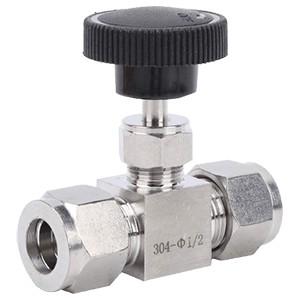
Common Needle Valve Types
1. Straight Needle Valve
Design: Inlet and outlet ports aligned on a straight path.
Application: General-purpose inline installations, analytical equipment, small-bore pipelines.
Benefit: Simple installation and compact layout.
2. Angle Needle Valve
Design: Inlet and outlet form a 90° angle.
Application: When directional flow change is needed without additional fittings.
Benefit: Saves space and reduces pressure drop caused by extra elbows.
3. Miniature Needle Valve
Design: Compact size with reduced flow capacity.
Application: Medical instruments, laboratory setups, micro-dosing systems.
Benefit: Ideal for space-constrained, low-flow environments.
4. High-Pressure Needle Valve
Design: Engineered to withstand pressures up to 60,000 psi.
Application: Hydraulic systems, research laboratories, offshore oil rigs.
Benefit: Enhanced safety and robust performance under extreme conditions.
5. Union Bonnet Needle Valve
Design: Threaded bonnet connection for easy disassembly.
Application: Systems requiring frequent inspection and maintenance.
Benefit: Better sealing performance, high reliability.
6. Forged Needle Valve
Design: Made from forged metal (typically stainless steel or brass).
Application: Corrosive and high-temperature environments.
Benefit: Greater mechanical strength and longer service life.
7. Bar Stock Needle Valve
Design: Machined from a solid bar for precise tolerances.
Application: Clean environments, like pharmaceuticals or food-grade systems.
Benefit: Smooth flow characteristics and exceptional consistency.
Manual VS Automatic Needle Valves
Manual: Operated by handwheel; best for low-frequency adjustments.
Automated: Actuated by electric or pneumatic systems; ideal for remote or high-cycle applications.
Selecting the Right Needle Valve
Fluid characteristics (viscosity, corrosiveness)
Pressure and temperature requirements
Frequency of operation
Space constraints
Desired precision of flow control