







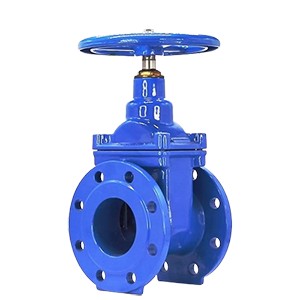
Gate valves are the most common valves in industrial piping, but they are not "one size fits all." If you choose the wrong type for your specific media or location, you risk thermal locking (where the valve won't open), stem leakage, or rapid corrosion.
1. The "General Purpose" Solution: Solid Wedge Gate Valves
Best For: Clean water, oil, air, and stable temperatures.
If you are working on a standard water line or a general utility pipe where the temperature doesn't fluctuate wildly, this is your industry standard. The "disk" inside is a single, solid piece of castmetal.
Why use it: It is the most robust and simple design. Because the wedge is solid, it resists vibration well and can be installed in almost any orientation (horizontal or vertical).
The Risk: If used in high-temperature steam lines, a solid wedge can suffer from "thermal locking." As the pipe heats up and expands, it can pinch the wedge so tightly that it becomes impossibleto open once the system cools down.
2. The "High Heat" Solution: Flexible Wedge Gate Valves
Best For: Steam systems and refining processes.
Does your system cycle between hot and cold? If so, a solid wedge might get stuck. The Flexible Wedge looks like a solid piece, but it has a deep cut (or relief) around the perimeter. This turns the wedge into a stiff spring.
Why use it: That slight flexibility allows the disk to compress slightly when the valve seats expand due to heat. It ensures a tight seal without getting permanently jammed during temperature swings.
The Risk: Because the wedge has a cut in it, it is not suitable for dirty fluids or slurries. Sediment can get packed into the cut, preventing the valve from closing.
3. The "Slurry & Solids" Solution: Knife Gate Valves
Best For: Wastewater, paper pulp, thick sludge, and viscous oil.
Standard gate valves have a problem with solids: debris gets trapped in the bottom of the valve seat, preventing the wedge from closing all the way. The Knife Gate solves this by changing thegeometry entirely.
Why use it: Instead of a wedge, the gate is a flat, sharpened stainless steel blade. When you close the valve, the blade physically cuts through the sludge, chopping up any solids that block itspath. It is self-cleaning.
The Risk: These are generally designed for low-pressure systems. They are not meant for high-pressure gas applications.
4. The "Safety & Visibility" Solution: Rising Stem (OS&Y)
Best For: Fire protection systems and critical isolation points.
In a fire or emergency, you don't have time to walk up to a valve, grab the wheel, and turn it to see if it's open. You need to know instantly.
Why use it: The OS&Y (Outside Screw and Yoke) design moves the threaded stem upwards as the valve opens. If the stem is sticking up, the valve is open. If the stem is down, the valve isclosed. This provides immediate visual confirmation from a distance.
Bonus: Because the threads are outside the valve body, they are not exposed to the water/fluid, preventing thread corrosion.
5. The "Tight Space" Solution: Non-Rising Stem (NRS)
Best For: Underground pipes, manholes, and tunnels.
Sometimes, you don't have vertical room for a stem to rise up. If you are installing a valve in an underground box or a cramped mechanical room, every inch counts.
Why use it: When you turn the handle, the stem rotates in place, and the gate climbs up the stem inside the valve body. The overall height of the valve never changes.
The Risk: You cannot tell if the valve is open or closed just by looking at it. Also, because the threads are inside the fluid, they are more prone to wear and corrosion over time.