







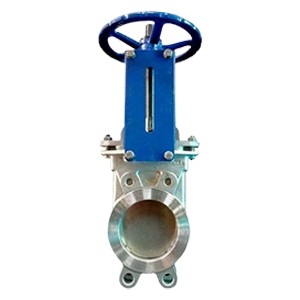
A knife gate valve is designed with a sharp-edged blade that moves up and down perpendicular to the flow of the media. This blade literally slices through thick or viscous fluids, ensuring complete shutoff even when solid particles are present.
When open, the gate lifts entirely out of the flow path, allowing full-bore flow with minimal pressure drop. When closed, it cuts through the slurry or debris and seals tightly against the seat, preventing leakage. This unique mechanism distinguishes it from traditional gate valves, which can easily clog when used in dirty or viscous media.
2. Design and Construction
The body of a knife gate valve is typically made from cast iron, ductile iron, carbon steel, or stainless steel. The gate itself is polished and sharpened to reduce friction and improve sealing efficiency. Seat materials vary — EPDM, PTFE, and NBR are common options that offer resistance to abrasion and chemical corrosion.
Some designs feature a resilient seat that provides a bubble-tight seal even under low-pressure conditions. Others use a metal-to-metal seat for high-temperature or abrasive environments. Depending on the installation, the valve can be operated manually, pneumatically, or electrically.
3. Key Applications
Mining: Transporting mineral slurries and tailings.
Pulp & Paper: Managing pulp stock with high solid content.
Wastewater Treatment: Handling sludge and raw sewage.
Power Generation: Controlling fly ash and cooling water.
Chemical Industry: Managing corrosive fluids and chemical mixtures.
Their ability to function in environments with solid-laden fluids makes them far more dependable than ball or globe valves in such applications.
4. Advantages of Using Knife Gate Valves
Clog-Resistant Design: The sharp-edged blade cuts through deposits, preventing blockages.
Low Pressure Drop: When open, the gate provides a full, unobstructed flow path.
Cost Efficiency: Simple structure with fewer components reduces maintenance costs.
Compact and Lightweight: Easier to install in confined spaces.
Versatile Actuation Options: Available with handwheel, pneumatic, or electric actuators.
For industries facing tough flow challenges, these advantages translate into higher reliability, less downtime, and longer equipment lifespan.
5. Choosing the Right Knife Gate Valve
Media Characteristics: Abrasive, corrosive, or viscous?
Operating Pressure and Temperature: Ensure materials match process conditions.
Size and Actuation Type: Choose between manual or automated control.
Seat Material: Match chemical compatibility and required sealing performance.
At Qingdao I-Flow, we offer knife gate valves engineered to meet global standards, including DIN, ANSI, and JIS. Our valves come with various body materials, seat configurations, and actuation options to meet the unique requirements of every project.
6. Why You Need Knife Gate Valves
If your operation involves slurry pipelines, wastewater systems, or high-solid processes, a knife gate valve is not just an option — it’s a necessity. These valves ensure uninterrupted performance, reduce maintenance, and improve system reliability.Knife gate valves are an investment in performance, safety, and long-term operational efficiency.