







What Is a Butterfly Valve
A butterfly valve is a type of quarter-turn valve used to start, stop, and regulate water flow. Its key component is a rotating disc positioned in the center of the pipe. A shaft connects the disc to an actuator or manual handle. When the disc is turned parallel to the flow, the valve is open; when perpendicular, the valve is closed.
The design is valued in fire protection because it combines simplicity with reliability. Unlike gate valves, which require multiple turns to open or close, butterfly valves operate with just a 90° rotation. This allows for faster response times during emergencies.
Why Butterfly Valves Are Used in Fire Protection
Compact and space-saving – Ideal for high-rise buildings and facilities where equipment rooms are tight.
Cost-effective – Lower material and installation costs compared to gate valves, especially for large diameters.
Quick operation – Quarter-turn design ensures rapid response, which is vital during fire emergencies.
Visual position indicators – Many butterfly valves have supervisory switches or indicators, showing whether the valve is open or closed.
Compliance with fire codes – UL and FM-approved butterfly valves are recognized under NFPA 13 as acceptable control valves for sprinkler and standpipe systems.
These features make them particularly effective for isolation and system control in fire protection.
Types of Butterfly Valves Used in Fire Protection
1. Wafer-Style Butterfly Valves
Installed between two flanges with bolts running through the body.
Lightweight and economical.
Best for systems where valves are not exposed to extreme pressure.
2. Lug-Style Butterfly Valves
Feature threaded inserts around the valve body for secure bolting.
Allow one side of the piping to be disconnected without disturbing the other.
Stronger and suitable for dead-end service.
3. Grooved-End Butterfly Valves
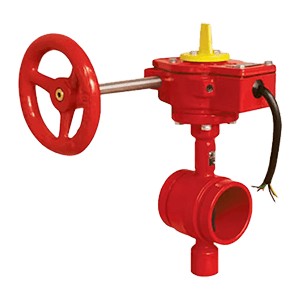
Common in fire protection piping because of easy installation with grooved couplings.
Require less labor and tools, making them cost-effective for large projects.
4. OS&Y (Outside Screw and Yoke) Butterfly Valves
Provide a visual indication of the open or closed position.
Often used in fire protection risers and main control valves.
Preferred for inspection and code compliance.
5. Supervisory Switch-Equipped Butterfly Valves
Integrated with tamper switches connected to the fire alarm system.
Alert building management if the valve is closed when it should be open.
Essential for compliance with NFPA 72 (National Fire Alarm and Signaling Code).
Applications of Butterfly Valves in Fire Protection
Sprinkler systems – Control valves that allow isolation of different zones.
Standpipe systems – Distribute water across multiple floors in high-rise buildings.
Fire pump discharge lines – Control water supply from pumps to the distribution system.
Zone isolation – Allow repairs or inspections without shutting down the entire building system.
Backflow prevention assemblies – Often paired with check valves in fire protection water supply systems.
Advantages Over Gate Valves
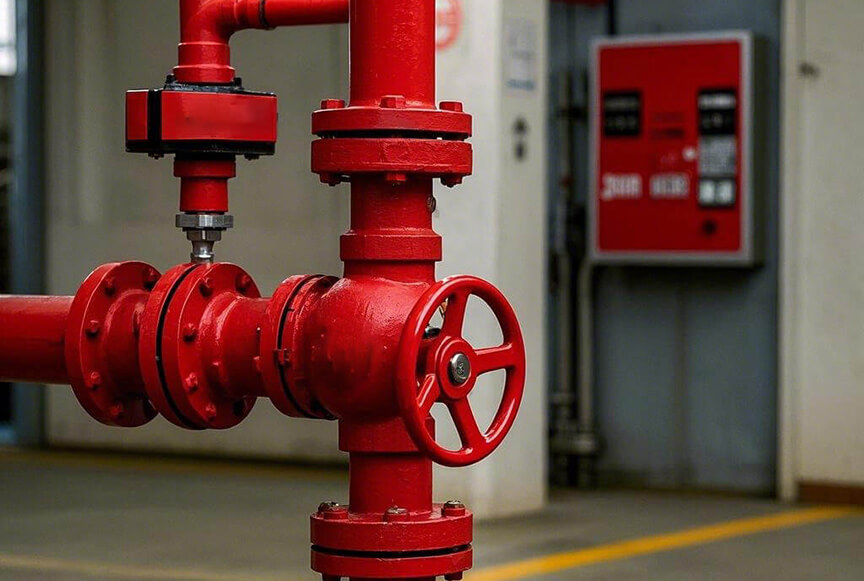
Size and weight – Butterfly valves are lighter and more compact, making them easier to install in tight spaces.
Speed of operation – A gate valve may require multiple turns to open; a butterfly valve takes a single 90° turn.
Cost efficiency – Particularly in larger diameters (8" and above), butterfly valves are significantly cheaper.
Integration with fire alarms – Butterfly valves often include tamper switches, whereas gate valves require additional components for monitoring.
Installation Considerations
Correct orientation – Install valves so the disc rotates fully without obstruction from the pipe wall or gaskets.
Accessibility – Valves should be placed in locations that are visible and easy to operate.
Supervisory wiring – Connect tamper switches to the fire alarm system for compliance with NFPA 72.
Hydrostatic testing – After installation, valves must pass hydrostatic pressure tests per NFPA 13.
Avoid over-torquing – Excessive tightening of flange bolts can distort the valve body.
Maintenance and Inspection Requirements
Monthly inspections – Verify that control valves are in the open position and that supervisory devices are functional.
Quarterly tests – Operate the valve through its full range of motion to prevent sticking.
Annual testing – Check supervisory switch signals at the fire alarm control panel.
Recordkeeping – Maintain documentation of all inspections and tests as required by AHJs (Authorities Having Jurisdiction).
Materials and Durability
Ductile iron bodies – Strong and impact-resistant.
Stainless steel or nickel-plated discs – Corrosion resistance for long-term service.
EPDM or NBR seats – Provide bubble-tight sealing.
Cost Considerations
Valve size – Larger diameters are more expensive but still cheaper than equivalent gate valves.
End connection type – Grooved-end valves are faster to install, reducing labor costs.
Supervisory features – Valves with tamper switches cost slightly more but are required for compliance.
Over the life cycle, butterfly valves often save money through lower installation, reduced maintenance, and longer service life.
Common Mistakes to Avoid
Not wiring supervisory switches – This can lead to code violations and system impairment.
Using non-listed valves – Always ensure valves are UL/FM approved for fire service.
Installing in inaccessible areas – If the valve cannot be inspected or tested, it will not meet NFPA 25 requirements.
Incorrect gasket selection – Poor gasket compatibility can cause leakage or disc obstruction.